
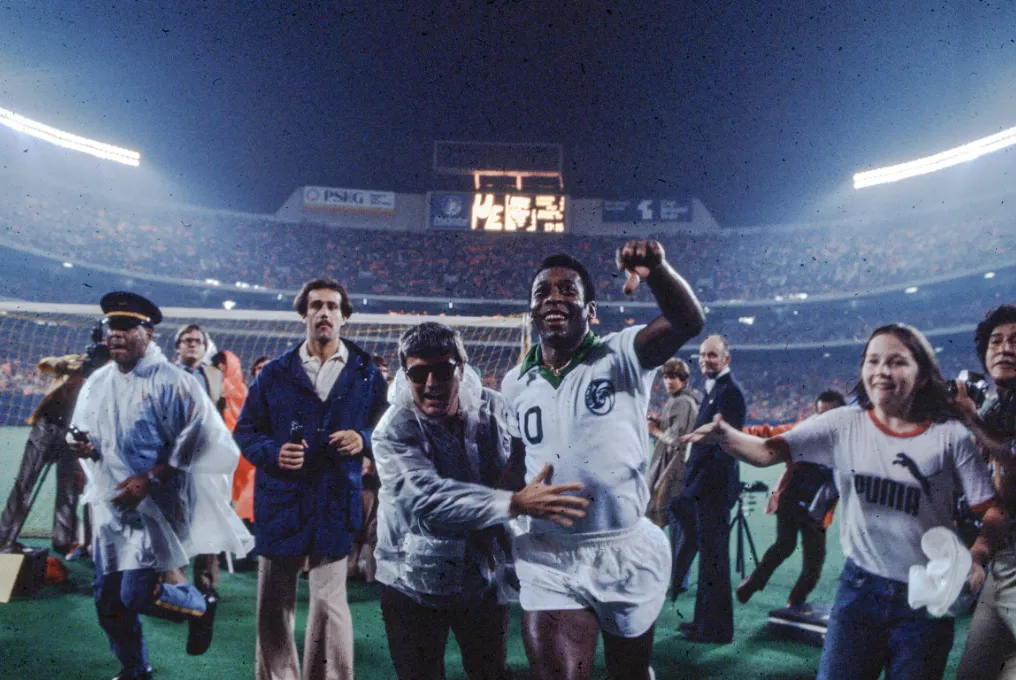
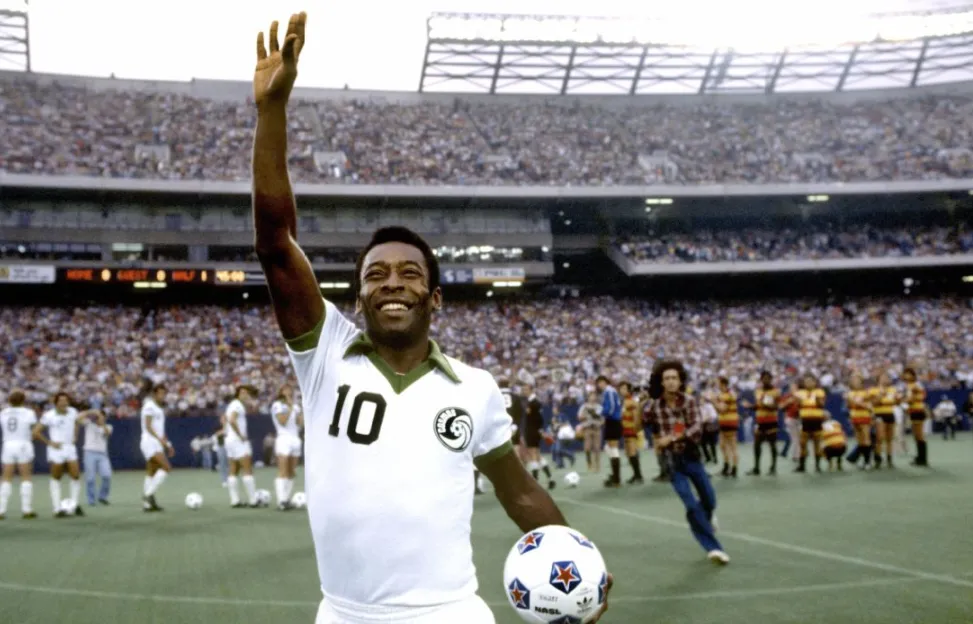
It’s a story that sounds almost too incredible to believe: the greatest footballer who ever lived, at the peak of his global fame, decided to trade the iconic yellow jersey of Brazil for the green and white of a club most people had never heard of—the New York Cosmos. This wasn’t just a transfer; it was a cultural earthquake. When Edson Arantes do Nascimento, known to the world as Pelé, stepped onto American soil in 1975, he didn’t just join a team. He single-handedly planted the seed for a soccer revolution in a country that was, at the time, utterly indifferent to the beautiful game.
For many younger fans today, it’s hard to imagine a world where the United States wasn’t a major player in soccer. But back in the mid-1970s, the North American Soccer League (NASL) was a fledgling, struggling league playing in half-empty stadiums. The sport was a niche interest, often played by immigrants and college kids. Pelé’s arrival changed everything. The contract was a landmark deal, reportedly worth $4.5 million a year, which made him the highest-paid team athlete in the world at the time. It wasn’t just about the money, though. It was about a mission. Pelé saw the potential to truly globalize the sport he loved, and the United States, with its massive market and media machine, was the ultimate frontier.
The Cosmic Impact: More Than Just a Player
Pelé’s impact on the Cosmos and the NASL was immediate and staggering. He brought a level of skill, charisma, and star power that the league had never seen. Suddenly, the New York Cosmos weren’t just a club; they were a global phenomenon. Celebrities like Mick Jagger, Robert Redford, and Henry Kissinger were regulars at Giants Stadium. The team became a magnet for other aging international stars like Franz Beckenbauer, Giorgio Chinaglia, and Carlos Alberto, creating a “Galácticos” team years before the term was even invented.
Redefining American Soccer Culture
Before Pelé, soccer in the US was often a kids’ game or a hobby for immigrants. He transformed it into a spectacle. The Cosmos’ matches became events, not just games. The atmosphere was electric, a mix of football fanaticism and 1970s New York glamour. He didn’t just play; he performed. Every touch, every pass, every goal was a lesson. He taught American audiences what the world already knew—that soccer could be an art form. The Cosmos drew record crowds, selling out stadiums across the country and forcing a football-obsessed nation to take notice of what was happening on the pitch.
As legendary sports commentator, James “Jimmy” O’Sullivan, once noted, “To understand the Pelé effect, you have to understand the landscape of 1975 America. There was no soccer. There was baseball, football, and basketball. Pelé didn’t just walk into a league; he walked into a vacuum and filled it with magic. Every stadium he visited was a miracle of marketing and raw, undeniable talent.”
The Statistics of a Legend: Pelé’s Numbers with the Cosmos
While Pelé was past his absolute physical peak when he joined the Cosmos at age 34, his statistics were still remarkable. He played for the club from 1975 until his retirement in 1977, and in that short time, he left an indelible numerical mark on the franchise.
A Goal-Scoring Machine in a New World
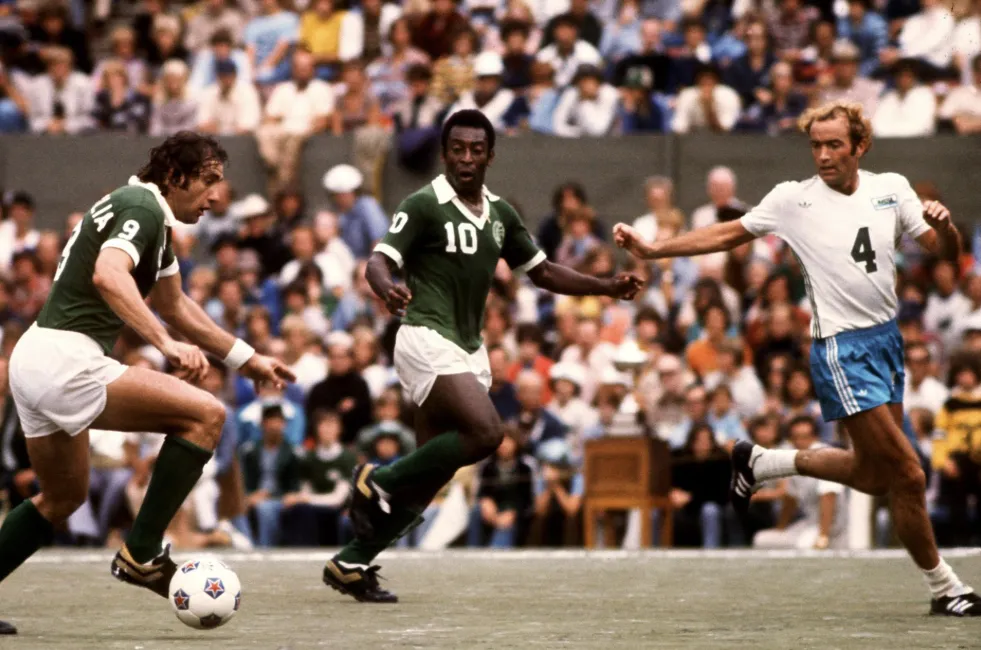
In his first season (1975), he scored 9 goals and added 8 assists in just 14 games, but it was the 1976 season that truly showcased his enduring class. He netted 13 goals and provided a staggering 18 assists in 24 games, leading the Cosmos to their first-ever NASL championship. Overall, in his three seasons with the Cosmos, Pelé scored 37 goals and recorded an incredible 31 assists in 64 regular-season matches. Of course, statistics don’t tell the whole story. His presence lifted the entire team’s performance. He turned a good team into a dynasty, winning the Soccer Bowl, the NASL championship, in both 1976 and 1977.
His final game, the legendary “Pelé Final” in 1977, was a perfect capstone to his American adventure. An exhibition match between the Cosmos and his beloved Santos, it was a celebration of his career. Thousands of fans packed Giants Stadium for one last chance to see the King. He played the first half for the Cosmos and the second for Santos, scoring a powerful free kick for New York before the match ended in a 2-1 victory for the Cosmos. It was a Hollywood ending for a man who had given American soccer its first real Hollywood story.
According to sports historian and analyst Dr. Eleanor Vance, “Pelé’s statistics with the Cosmos are impressive, but they don’t capture his true contribution. He was the league’s greatest ambassador. The 31 assists he provided are a testament to his unselfish play. He wasn’t just a goal scorer; he was a soccer educator. Every game was a clinic on movement, passing, and vision.”
A Lasting Legacy: From the Cosmos to Today’s Soccer Boom
The New York Cosmos didn’t last. The NASL folded in 1984, a victim of rapid over-expansion and financial mismanagement. But the seeds Pelé planted took decades to bloom. The American kids who watched him play in the 1970s are now the coaches, administrators, and fans who built Major League Soccer (MLS). The infrastructure and passion he helped create laid the groundwork for the US to host the 1994 FIFA World Cup, a tournament that permanently changed the sport’s profile in the nation.
The Echo of the King in Modern America
Today, the United States is a soccer powerhouse. MLS is a stable, growing league that attracts global stars. The sport is played by millions of kids, from suburban parks to inner-city streets. And it all traces back to that moment in 1975 when a 34-year-old Brazilian stepped off a plane in New York and said, “I am here to make soccer a big sport in America.”
The Crickex perspective on this era is one of pure awe. It wasn’t about winning every game; it was about winning hearts and minds. Pelé didn’t just rule soccer in the US; he taught the country how to fall in love with it. He was a prophet of the beautiful game, and his time with the Cosmos was a three-year sermon that is still being preached today. The stadiums are full, the TV ratings are high, and the US Men’s and Women’s National Teams are competitive on the world stage. Every time a child scores a goal in a park in an American city, there’s a piece of Pelé’s legacy in that moment.
Key Milestones and Matches of the Pelé-Cosmos Era
To truly appreciate the magnitude of Pelé’s impact, it helps to look at a timeline of his most defining moments in New York.
The Debut That Changed Everything
- Date:June 15, 1975
- Match:New York Cosmos vs. Dallas Tornado
- Significance:Pelé‘s first game for the Cosmos. He didn’t score, but he created the team’s only goal in a 2-2 draw. The game was broadcast nationally and drew the largest TV audience ever for a soccer match in the US at that time.
The First Goal
- Date:June 29, 1975
- Match:New York Cosmos vs. Toronto Metros-Croatia
- Significance:Pelé scored his first goal for the Cosmos. It was a typical piece of Pelé magic—a perfectly timed run and a cool finish. The crowd erupted, and for the first time, American sports fans truly saw the genius in action.
Winning the First Championship
- Date:August 28, 1976
- Match:Soccer Bowl ’76: New York Cosmos vs. Seattle Sounders
- Significance:Pelé led the Cosmos to their first NASL title, scoring the opening goal in a 3-0 victory at the Kingdome in Seattle. He was awarded the game’s MVP, cementing his status as the king of American soccer.
The Final Farewell
- Date:October 1, 1977
- Match:New York Cosmos vs. Santos FC (Pelé’s Farewell Game)
- Significance:The emotional climax of his career. Played in front of 75,646 fans at Giants Stadium, the game was a tribute to his two great loves. His free-kick goal for the Cosmos was the perfect final act.
The Tactical Genius: Pelé’s Role in the Cosmos System
From a tactical perspective, Pelé was deployed in a free role, often as a withdrawn striker or a classic number 10. He was the creative heartbeat of the team, operating just behind the main striker, Giorgio Chinaglia. His job was to orchestrate the attack, find space between the lines, and deliver killer passes. Chinaglia, a prolific Italian striker, was the pure finisher, while Beckenbauer, the German sweeper, directed the defense from the back.
This setup was revolutionary for its time in the US, where teams often played a more direct, physical style. Pelé’s presence forced the Cosmos to play a more possession-based, technical game. He was a master of the “one-two” pass and the “no-look” pass. He used his incredible body feints and low center of gravity to beat defenders in tight spaces. For American audiences who were used to the linear power of American football, watching Pelé’s creativity and improvisation was a revelation. He showed that soccer was a game of endless possibilities, where a single moment of genius could decide a match. The Crickex community of soccer fans still debates which of his Cosmos goals was the most beautiful, a testament to the sheer volume of magic he produced.
Conclusion: The Eternal King of American Soccer
When Pelé ruled soccer in the US with the New York Cosmos was more than a chapter in sports history; it was a cultural turning point. He was the pied piper who led a nation to a new game. The statistics, the goals, and the championships are part of the record, but the true legacy is the vibrant, passionate soccer culture that now thrives in America. Every “U-S-A!” chant in an MLS stadium, every kid dreaming of playing for the national team, carries the echo of Pelé’s time in New York.
His tenure with the Cosmos wasn’t just about winning; it was about building a foundation. He showed that a simple ball and a field could create a shared language of joy. While the NASL eventually faded, the spark Pelé ignited never went out. It grew into a flame that now burns brightly across the country. As we look forward to more World Cups and a growing domestic league, we should always remember the man who started it all on a summer evening in 1975.
What are your favorite memories of Pelé‘s time with the Cosmos? Do you think any modern player could have a similar impact on a new market? Share your thoughts in the comments below, and don’t forget to explore more iconic moments in soccer history right here on our website. The King may be gone, but his kingdom, built on a foundation of beautiful football, lives on forever.
